Preview mode: the checkout links haven’t been added yet, so the buy buttons scroll to the offer instead of opening Selar.
For sisters at home and abroad · by Precious Suas

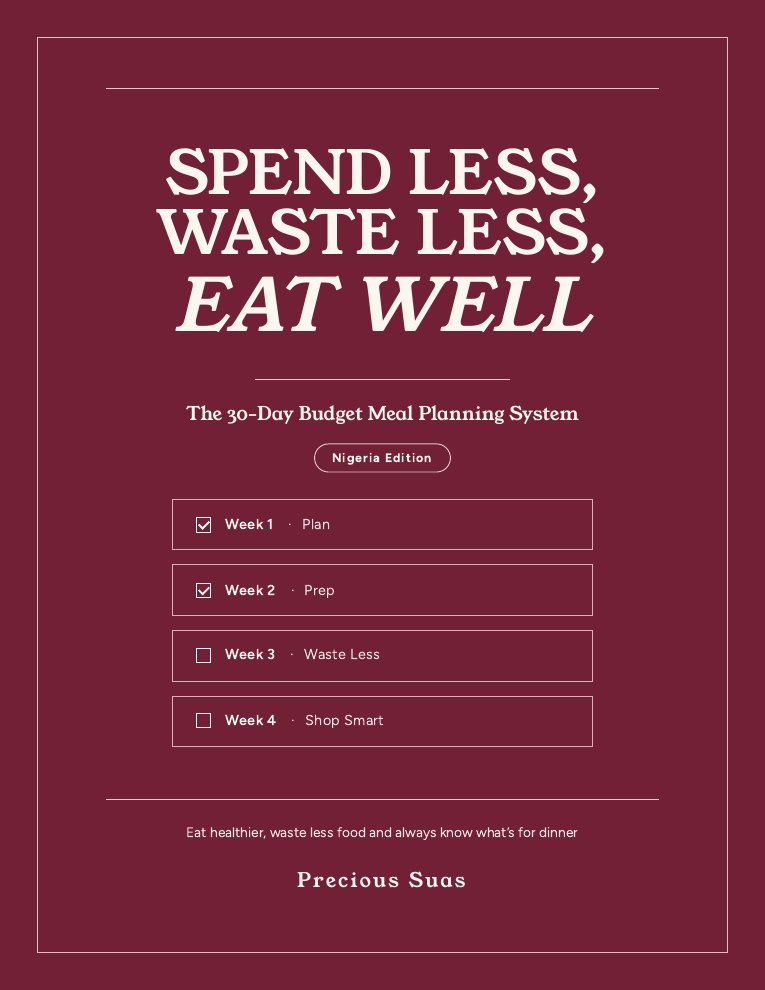
Spend Less,
Waste Less,Eat Well

The 30-Day Budget Meal Planning System

The forgotten market-day ritual our then-young grandmothers used to feed a whole household well on small money, now turned into a simple 30-day system that helps you plan a full week of healthy meals, shop with one organised list and stop throwing food away… without starving your family, without guessing what to cook every evening, or without watching your foodstuff money finish before month end.

Instant downloadNigeria & US editions14-day promise

Dear Sister,

I know that feeling when you enter the market with ₦20,000 in your bag, and you come back with two nylon bags that cannot even make one proper week of food. Pepper has gone up again. Tomatoes have gone up again. The rice seller looks at you as if you should already know the new price.

I know 6pm, when everybody is hungry and someone asks, “Mummy, what are we eating?” And you open the fridge, look inside, and close it again. Because there is food in there, yes. But there is no plan.

I know the tomatoes that rotted at the bottom of the basket. The half pot of soup that turned sour when light went and did not come back for two days. The ugu you bought fresh on Saturday that was yellow by Tuesday. You are not careless, sister. You are tired, and nobody ever showed you a system.

I know the evenings you gave up and ordered food on the app. ₦6,500 for one plate, plus delivery. You ate it, but it did not sit well with your spirit, because you knew that money could have fed the house for two days.

And sister, if you live abroad, in Houston, London or Toronto, I know your version too. The supermarket where nothing feels cheap. The African store where one small bag of garri costs what a full paint bucket costs at home. The delivery app you open on a cold evening because you are too tired to think about dinner. Different country, same story.

And I know the quiet part, the part you don’t say out loud. When your husband asks, “Where did the foodstuff money go?” and you don’t have an answer. When you scroll past those healthy meal plans on Instagram, full of salmon and avocado, and you think, eating well is for people with money.

Sister, that is not true. And by the end of this page, you will see why.
You are not lazy

What you have already tried

You have tried. Let me show you that I understand exactly what you have tried, and why it didn’t work.

  1. Buying everything in bulk at the big market.

    You went to Mile 12 or Bodija or Ogbete to buy in bulk and save money. But half the tomatoes spoiled before you could use them, and the money you “saved” went straight into the dustbin.

  2. Following meal plans from Instagram and YouTube.

    They looked beautiful. But they called for ingredients you cannot find in your market, at prices that made you laugh. You gave up by day three.

  3. Cutting portions and skipping meals.

    You thought eating less would save money. Instead, everyone was hungry by 4pm, so you bought snacks, puff-puff and minerals, and spent more than before.

  4. Cooking one big pot of stew to last two weeks.

    It sounded smart. But by day five, nobody wanted to see that stew again. Some of it went bad when light went off, and the rest was eaten with complaints.

  5. Ordering food “just this once” to save time.

    Once became three times a week. The app knows your address better than your in-laws do.

  6. Writing down every naira you spend.

    You tracked it. You saw the number. But tracking did not tell you what to cook tomorrow or what to buy on Saturday.

None of these worked because none of them addressed the ROOT of the problem. The problem was never just the price of food. The problem is shopping without a plan, cooking without a system and storing food without knowing how to keep it.

The forgotten wisdom

What our grandmothers knew

Our grandmothers did not have supermarkets. They did not have food delivery apps. They did not have Instagram nutritionists. Many of them did not even have a fridge. And yet they fed big households, three times a day, with healthy food, on very little money. And almost nothing went to waste.

How? Because our grandmothers had a market-day ritual. It was never written down. It was simply how things were done.

She knew what she had

Before market day, she checked her baskets, pots and storeroom: how much garri, ewa and ede remained. She never bought what she already had.

She bought for meals, not for her eyes

She went to market knowing what the family would eat that week. One trip, one purpose. No “let me just buy this one.”

She cooked once, they ate twice

One pot of ofe or obe became dinner today, lunch with rice tomorrow and a fast meal with yam the day after.

She bought in season

When tomatoes were cheap, she bought plenty and ground and fried them or dried them. When they were expensive, she used less.

She used everything

Overripe plantain became dodo or ukpo ogede. Leftover beans became akara. In her kitchen, “spoil” was not an option.

Know what you have. Plan before you buy. Cook once, eat twice. Store it well. Use it up.

Then modern life came. Supermarkets, impulse buying, delivery apps, and the habit of deciding what to cook at 6pm with an empty stomach. Somewhere in the middle of all that, we lost our grandmothers’ system. Not because it stopped working, but because nobody wrote it down for us.

So I did. Spend Less, Waste Less, Eat Well turns their wisdom into a clear 30-day system for a modern kitchen: step by step, one day at a time, with worksheets you fill in with your own market prices and your own family’s food. No strange ingredients. No starving. No guesswork.

What is inside the guide

30 days. One clear result each day.

The guide comes in two editions, the Nigeria Edition and the US Edition (you will choose yours below). Both follow the same 30-day system, beautifully designed and easy to read on your phone or print at home.

Every single day has the same seven parts: today’s outcome, a short lesson, a practical exercise, a realistic example, a sample answer to show you exactly what “done right” looks like, a printable worksheet and a daily checklist.

Days 1–7

Build your first affordable week · page 7

  • Day 1: find out what you really spend on food, including the money that “disappears” on snacks and takeaways
  • Day 2: the kitchen inventory and your Use-First List, so you stop buying what you already have
  • Day 3: set a realistic budget and your cost per plate
  • Day 4: build your staples list
  • Day 5: plan a full 7 days with the simple Meal Formula, plus a ready-made sample week
  • Day 6: one organised list, priced before you leave the house
  • Day 7: shop with discipline, then a prep session that makes your week easy
Days 8–14

Cook once, eat twice · page 33

  • The batch-cooking method for the whole week
  • Five foundation recipes with Naira cost per serving: mother stew, beans porridge, efo riro, jollof rice and yam porridge
  • Make-ahead breakfasts like moi moi cups and groundnut banana oats
  • The Leftover Remix chart: last night’s dinner becomes a different lunch
  • Homemade spice blends and sauces
  • How to find the cheapest protein at your market
Days 15–21

Waste less · page 59

  • Arrange your fridge and freezer so food lasts longer, plus your power-cut plan for when light goes
  • “Best before” vs. “use by”: when food is still good
  • Five rescue meals for food about to spoil
  • The food waste log that shows where your money is leaking
  • A portion guide, so you cook enough, not too much
Days 22–30

Shop smarter & lock it in · page 84

  • How to know which size is really cheaper
  • Market days, closing-time deals and the tomato seasons
  • The 5 questions to ask before you buy anything in bulk
  • Your 15-minute emergency meal list
  • One pot for a household with different needs, including a picky child
  • Your 4-week meal rotation and 30-minute weekly routine
Appendices

Your kitchen reference · page 113

  • 30 Nigerian recipes and formulas, from egusi and okro soup to native jollof and agoyin-style beans, with Naira cost per serving, cooking time and freezing notes
  • Sample market lists in Naira for one person, a couple and a family of four
  • Storage and power-cut chart: how long yam, tomatoes, ugu, garri and more really last
  • Ingredient substitution guide, 35 printable worksheets, the 30-day master checklist and a guide to market measures like the derica and paint bucket

Page numbers are for the Nigeria Edition. The US Edition covers the same 30 days in the same order.

Choose your edition

Same system. Your kitchen.

The system is the same everywhere: plan before you buy, cook once and eat twice, store food well and use it up. What changes is where you buy your food and what you cook. So choose your edition by where you shop, not where you were born.

Nigeria Edition cover

Nigeria Edition

For sisters shopping in Nigerian markets and supermarkets

Prices
Naira
Shopping
Open market and supermarket: market days, closing-time deals, the derica and the paint bucket
Recipes
30 Nigerian recipes: mother stew, efo riro, egusi, okro soup, moi moi cups, native jollof and more
Food storage
Includes a power-cut plan for when light goes
Size
132 pages, 35 worksheets
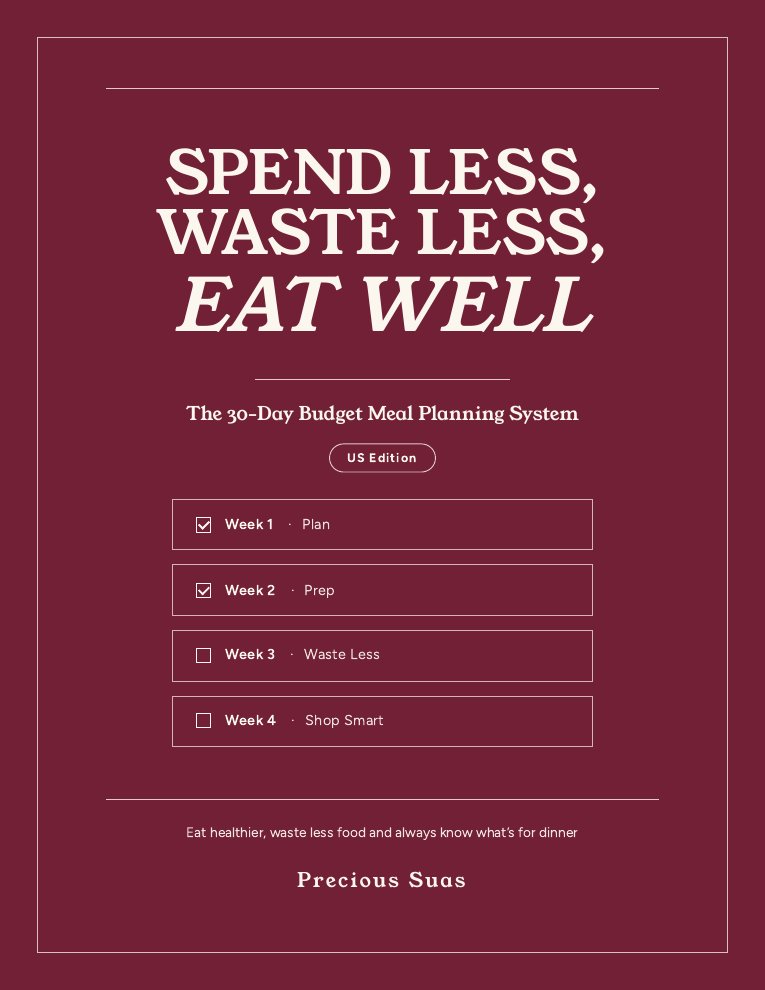
US Edition cover

US Edition

For sisters shopping in American supermarkets

Prices
US dollars
Shopping
Supermarket: shelf price tags, store brands, weekly sales, frozen and canned options
Recipes
31 everyday budget recipes: lentil soup, sheet-pan chicken, rice bowls, chili, curry and more, with vegetarian options
Food storage
Standard fridge and freezer guidance
Size
127 pages, 34 worksheets

Living in the UK, Canada or elsewhere? The method works anywhere. The US Edition’s examples are in dollars and based on supermarket shopping, so choose it if you mostly shop in supermarkets, and simply use your own prices in the worksheets. If you mostly cook Nigerian food from African stores, the Nigeria Edition’s recipes will feel like home.

An honest word

Be one of my first sisters

I will be honest with you, sister: this guide is brand new. You won’t see a long list of reviews here yet, because you are among the very first women to use it. I would rather tell you the truth than show you reviews from people who don’t exist.

So here is why you can try it with confidence.

Built on habits that already worked

Knowing what you have before market day, cooking once and eating twice, buying in season and wasting nothing: our grandmothers proved these long before I wrote them down.

You can check your own progress

Every day has a clear outcome. By Day 7 you will have a full week of meals planned and an organised list in your hand, and you will see your own numbers on the Day 1 and Day 21 trackers.

You are fully covered

If you follow the guide for 14 days and don’t have your week planned and your list ready, I will refund you. No long story.

The founding-sister price

The first 50 sisters on each edition pay half the regular price, as my thank-you for trying it first.

And I would love to hear from you. When you finish Week 1, send me a message and tell me how it went. With your permission, your words may be the first ones other sisters read on this page.

Take a look inside

Don’t just take my word for it

Here are real pages from the Nigeria Edition. Tap a page to see it bigger.

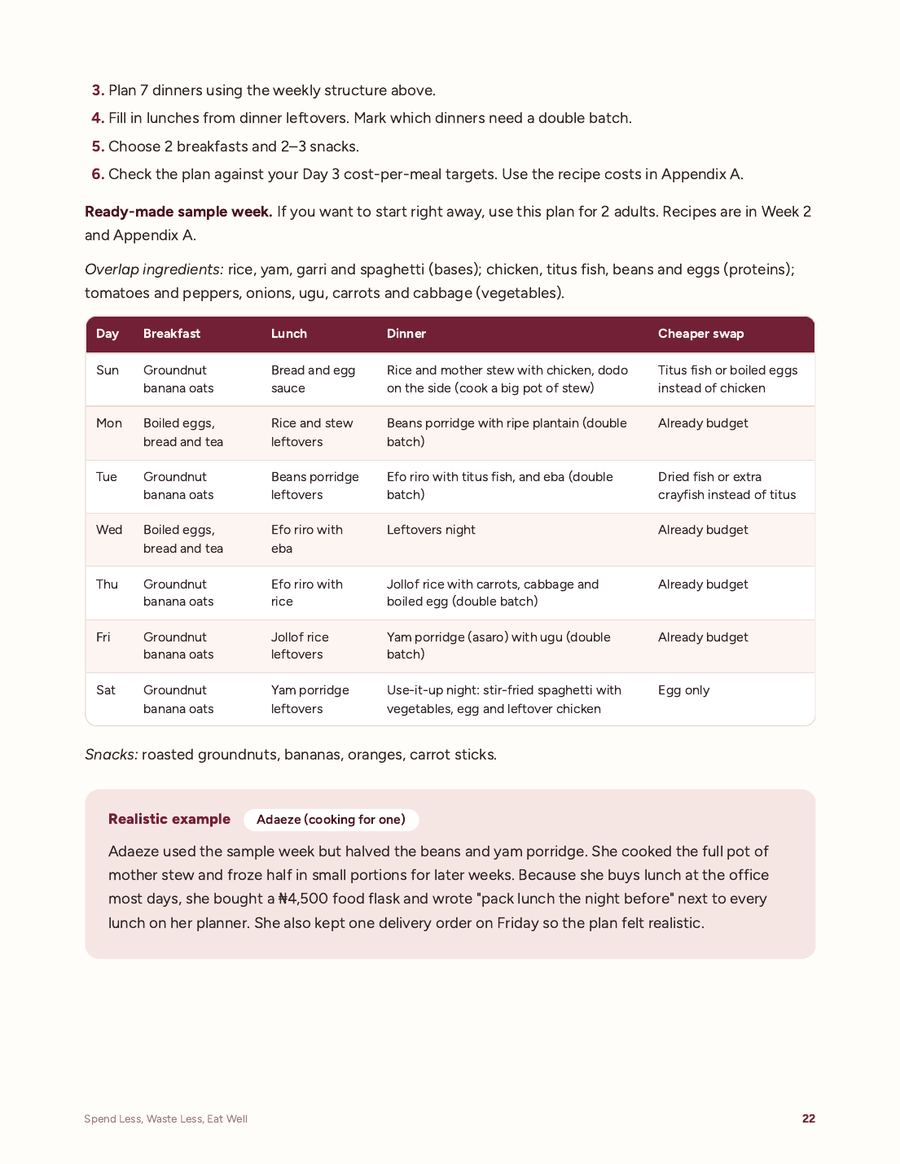
Day 5 page showing the ready-made sample week of Nigerian meals in a table
The ready-made sample week (Day 5): a full week of Nigerian meals you can start immediately.
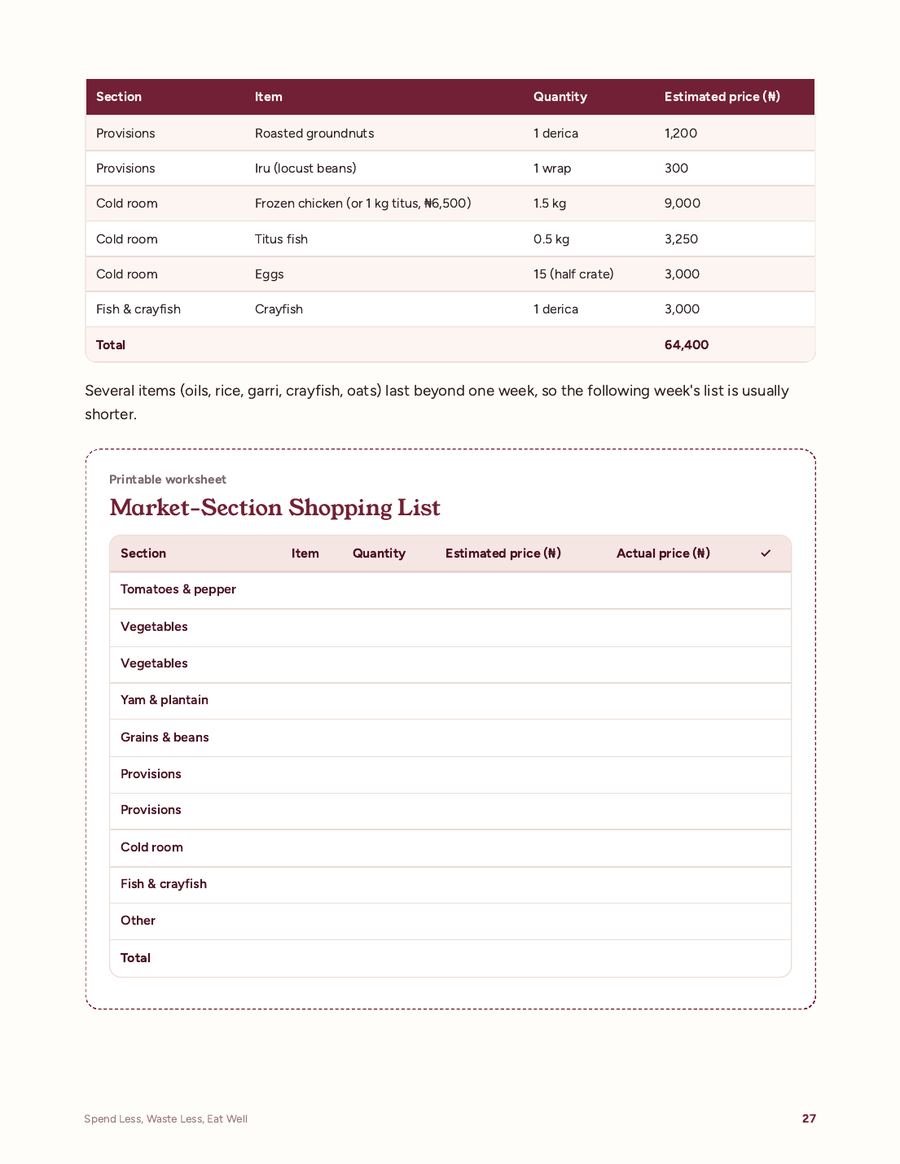
Day 6 page showing a market list sorted by section with Naira prices
The market list (Day 6), sorted by market section and priced in Naira.
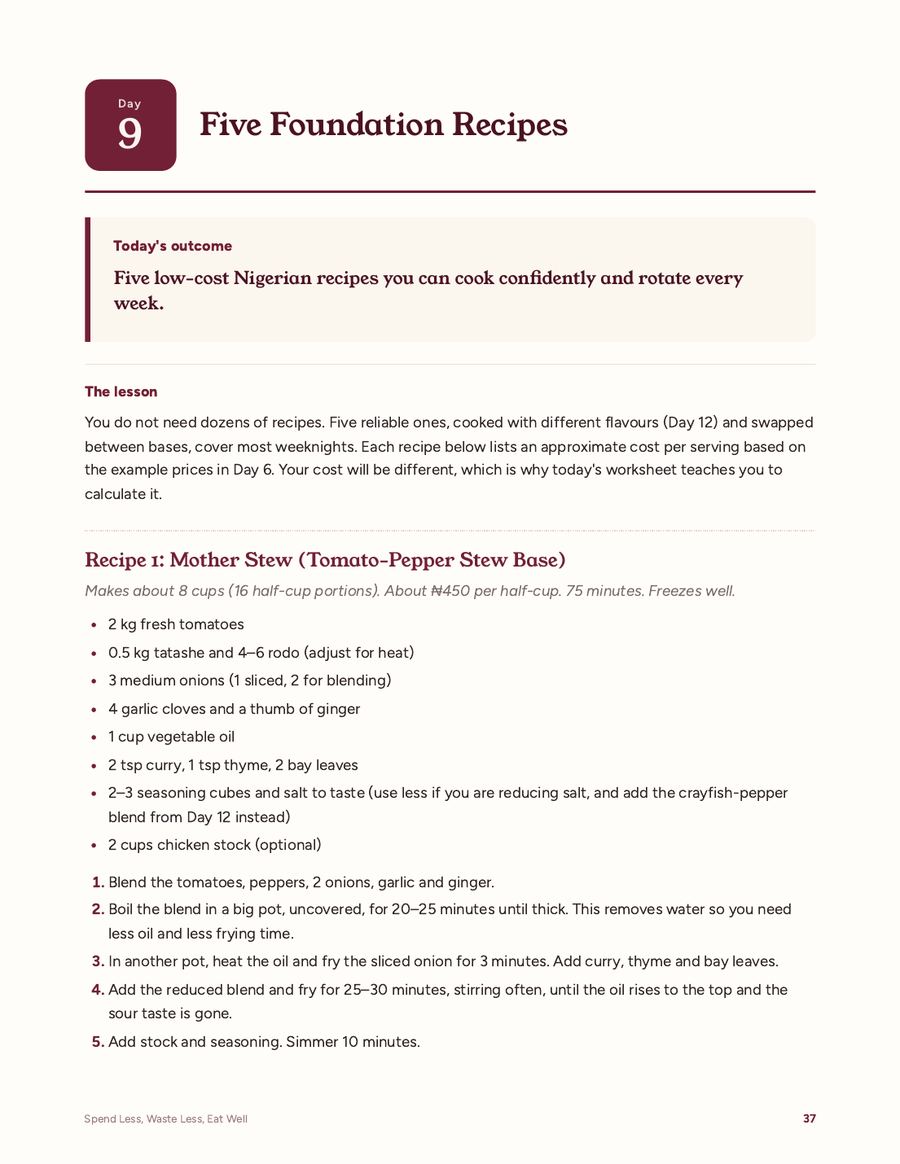
Day 9 page showing the mother stew recipe
Recipe 1, the mother stew (Day 9): one pot that becomes jollof rice, efo riro, egg sauce and more.
Here is everything you are getting today

The guide plus two bonuses

Nigeria Edition coverUS Edition cover

Spend Less, Waste Less, Eat Well

Your choice of edition: the 132-page Nigeria Edition (30 Nigerian recipes, 35 worksheets, prices in Naira) or the 127-page US Edition (31 recipes, 34 worksheets, prices in dollars). Both include the full 30-day system and the 4-week meal rotation.

Value: ₦15,000 / $34
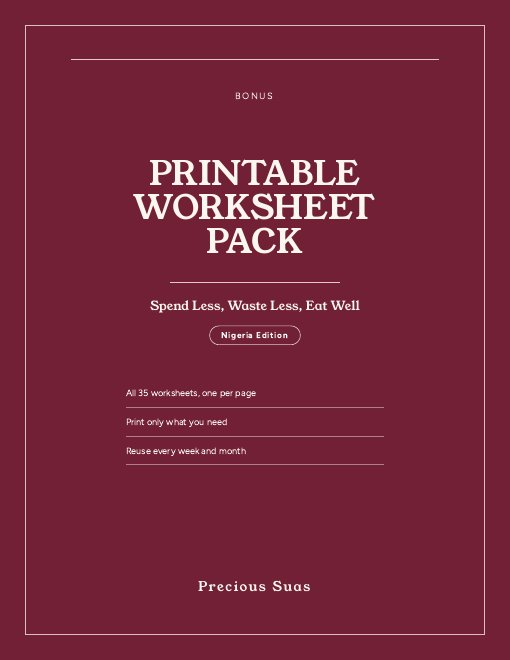
Printable Worksheet Pack cover

Bonus 1: The Printable Worksheet Pack

Every worksheet from your edition in one print-ready file, so you can print only what you need, week after week, without printing the whole guide.

Value: ₦5,000 / $12
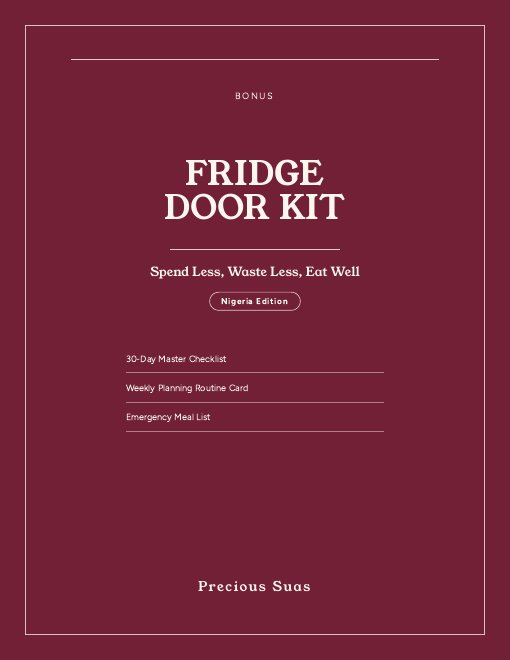
Fridge Door Kit cover

Bonus 2: The Fridge Door Kit

Three one-page sheets for your fridge: the 30-Day Master Checklist, the Weekly Planning Routine Card and your 15-Minute Emergency Meal List. When you are tired at 6pm, the answer is right there.

Value: ₦3,000 / $7
Your offer today

Choose your edition

Launch price for the first 50 sisters on each edition only. When 50 copies of an edition are gone, its price returns to ₦15,000 or $34. I will not announce it. The price will simply change.

Think about it this way: ₦7,500 is about the cost of one takeaway plate with delivery in Lagos, and $17 is about the cost of one delivered meal in the US. This guide helps you plan every plate for the next 30 days, and every month after.

How to pay

Simple, secure, instant

Pay with whichever method is easiest for you.

Nigeria Edition (pay in Naira)

  • Debit card: Verve, Mastercard or Visa
  • Bank transfer: pay directly from your bank app
  • USSD: pay from any phone, even without data

US Edition (pay in dollars)

  • Debit or credit card: Visa, Mastercard and other major cards, from anywhere in the world

Checkout for both editions is secure, and your guide and both bonuses arrive in your email instantly after payment, so you can start Day 1 tonight.

My 14-day promise to you

I am so confident in this system that I am putting my money where my mouth is. Follow the guide for 14 days. If you do the daily exercises and you still do not have a full week of meals planned and one organised shopping list in your hand, send me a message and I will refund every kobo (or every cent). No long story, no hard feelings.

Sister, let me be honest with you

Next month can look different

If nothing changes, next month will look like this month. The same rush at the market. The same 6pm panic. The same tomatoes in the dustbin, the same takeaway receipts, and the same quiet worry when foodstuff money finishes before salary comes.

Now picture Day 21. You have your Use-First list on the fridge. Your meals for the week are already decided. You went to market once, with one list, and came back with exactly what you needed. Your freezer is labelled. Last night’s stew became today’s lunch. And for the first time in a long time, you can see in your own handwriting how much less you are spending and wasting.

Our grandmothers did it with no fridge, no apps and no internet. You have everything they had, plus this guide. The only thing left is to start.

Instant download. Naira checkout by card, transfer or USSD; dollar checkout by card.

P.S. Remember: you are fully covered by my 14-day promise. Do the work, and if you don’t have your week planned and your shopping list ready, you get your money back. But the launch price (₦7,500 for the Nigeria Edition, $17 for the US Edition) is only for the first 50 sisters on each edition. After that, it goes back to ₦15,000 and $34. Grab your copy now while it is still at this price.

Get my copy now

Precious Suas

Spend Less, Waste Less, Eat Well · The 30-Day Budget Meal Planning System

Prices in the guide are examples and vary by market and season. This guide is not medical advice; if you have a health condition, follow your doctor’s advice.

© 2026 Precious Suas. All rights reserved.

Launch price₦7,500 · $17 · 14-day promise

Choose your edition